Request a quote or a walkthrough for your shop.
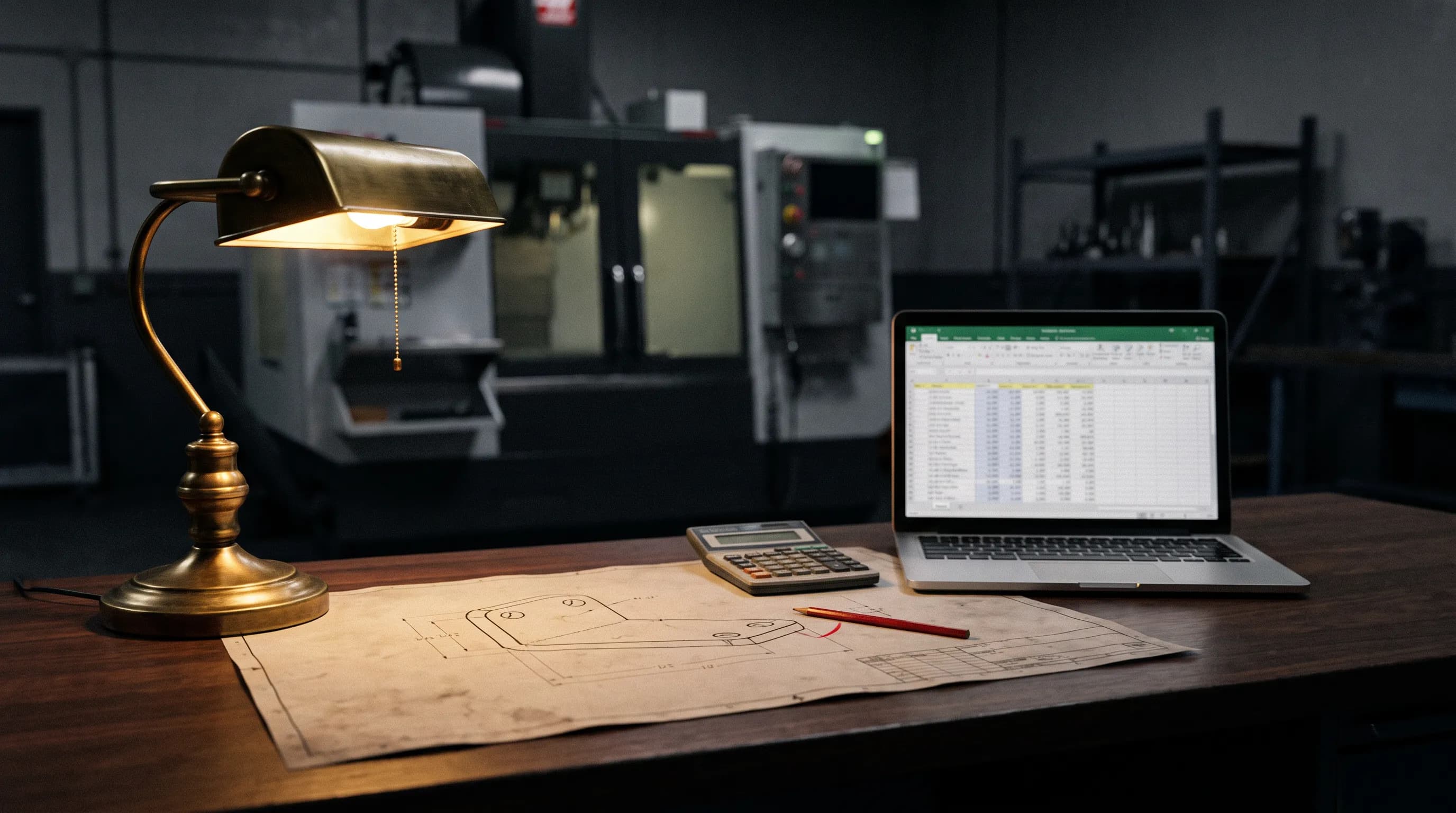
It's Wednesday and a customer wants a number on 200 aluminum housings by Friday. Your estimator has the drawing open and a nagging feeling you ran something close to it a couple of years ago. So she starts digging. Old job numbers, a closed-job screen, a spreadsheet somebody kept. Then she walks her assumptions down the hall and asks the owner, "Does this look right to you?" That second look is the tell. Nobody's sure, and everybody knows what's at stake. Misread one dimension on the drawing or guess setup too low, and you're the shop saying "we're losing our ass on this job" three weeks from now.
Where the stupid tax gets paid
Most shops don't have a quoting problem. They have a blank-page problem. Every week, every quote starts from scratch, even though the answer to half of it is sitting in jobs you already closed. Rebuilding from memory is where the stupid tax gets paid, and setup time vs run time is the usual place it hides. Setup is a one-time hit on each lot. Run time repeats with every piece. "That job took about six hours" tells you nothing until you know how much was fixture and first article and how much was cycle time stacking up. Remember the total and price a different quantity off it, and the quote is wrong before anyone sharpens a pencil.
Quote from job history by asking a question
The real figures are already in your job shop ERP. Epic One connects to the ERP you run, including Epicor Kinetic and E2 JobBoss², so the hunt becomes a sentence. "What did the last jobs like this actually cost us? Show setup time vs run time, scrap, and outside processing." It reads the closed job records and answers in plain language, instead of sending your estimator through a job list with thousands of rows. Then she keeps going, the way you would with a person who had the files open: "Which of those ran over on setup?" or "What quantity did the best one run at?" That's how you quote from job history without turning it into an archaeology project.
The double-check gets better too
This doesn't take the estimator out of the quote. Reading the drawing, judging a tight tolerance, deciding a rush is worth the premium, that's still a person's call, and it should be. What changes is the review. Instead of "does this feel right," whoever checks the number sees what the comparable jobs actually landed at and can argue with the gap. Epic One works through each user's own ERP login, so people see only what their login already allows, and it reads. If a task ever needs to write something back to the ERP, that goes through an approval step where a person signs off on the exact change.
An hour instead of a day
The goal isn't a faster guess. It's a quote you don't have to gut-check on Friday afternoon because the baseline came from jobs you really ran. Here's one thing to try before your next deadline: pick the part you quote most often and write down what you think it costs. Then find out what the last three runs actually did on setup and run time. The distance between those two numbers is the size of your stupid tax. If you want that lookup to be one question, tell us which ERP you're on and what you want off your estimator's plate on the Get Epic One page, and we'll set up your private instance and confirm the safety details before anything connects.
See it inside Epicor Kinetic
How Epic One reads live Kinetic and E2 JobBoss² data, gates every change behind human approval, and puts real answers ahead of another screen-hunting session.
Request a quote or a walkthrough for your shop
Tell us about your ERP and we’ll show you Epic One working on your kind of jobs, quotes, and POs.